
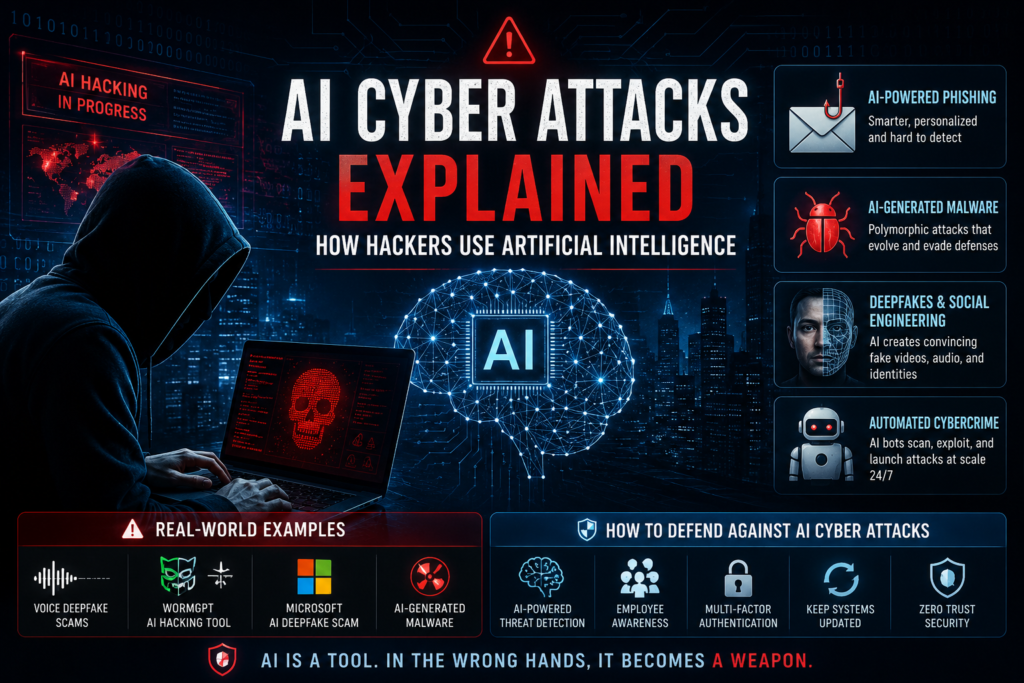
Artificial intelligence is rapidly changing the cybersecurity landscape. Today, hackers use AI to automate phishing campaigns, generate malware code, create deepfake scams, and launch cyber attacks faster than traditional methods. AI cyber attacks are becoming one of the biggest digital threats facing businesses, governments, and consumers worldwide. According to IBM Security, artificial intelligence is already reshaping both cyber defense and cybercrime.
In this guide, you’ll learn:
Some hiring hacker who have these type of technology
how organizations defend against AI-powered attacks
what AI cyber attacks are
how hackers use artificial intelligence
real-world cyber attack examples
AI phishing and deepfake threats
What Are AI Cyber Attacks?
Understanding AI-Powered Cyber Attacks
AI cyber attacks are cyber threats that use artificial intelligence to automate, improve, or accelerate malicious activities.
Unlike traditional cyber attacks, AI-powered attacks can:
- adapt in real time
- mimic human behavior
- automate decision-making
- evade traditional security systems
- scale attacks globally
According to CrowdStrike, cybercriminals increasingly rely on machine learning and generative AI tools to improve attack efficiency.
How Hackers Use Artificial Intelligence AI Phishing Attacks
The Evolution of Phishing
Traditional phishing emails were often easy to identify because of poor grammar or suspicious formatting. AI phishing attacks are much more convincing.
Hackers now use generative AI to create:
- personalized phishing emails
- fake support chats
- cloned writing styles
- multilingual scam campaigns
Related Resource
Real-World Example: MGM Resorts Cyberattack
In 2023, the MGM Resorts Cyberattack disrupted hotel operations, casinos, reservations, and digital systems across multiple properties.
Reports from Reuters Coverage of the MGM Cyberattack explained how attackers used sophisticated social engineering tactics to gain system access.
This event highlighted how modern cybercriminals combine automation, AI-driven reconnaissance, and social engineering techniques.
AI Deepfake Scams
Voice Cloning and Video Manipulation
AI deepfake technology allows attackers to generate fake audio and video recordings that imitate real people.
AI-powered deepfake attacks are increasingly used for:
- CEO fraud
- financial scams
- political misinformation
- impersonation attacks
Learn More
Real-World AI Voice Fraud Cases
Multiple international businesses have reported incidents involving AI-generated voice cloning used to authorize fraudulent money transfers.
According to Europol’s Report on AI and Cybercrime, deepfake technology and AI-enhanced fraud are becoming major concerns for financial institutions.
AI Malware and Autonomous Cyber Attacks
Smarter Malware
AI malware can:
- evade detection
- adapt dynamically
- automate exploitation
- identify vulnerabilities
Cybersecurity experts at Kaspersky Research warn that AI-enhanced malware may significantly increase attack sophistication in the coming years.
Automated Vulnerability Discovery related to AI cyber attacks
Artificial intelligence allows attackers to scan systems for weaknesses far faster than manual methods.
This dramatically increases:
- attack speed
- attack scale
- vulnerability exploitation rates
Additional Reading
AI Cyber Warfare and Nation-State Threats
Governments and AI Security Risks
Security experts warn that AI cyber warfare could become one of the biggest geopolitical risks of the decade.
Governments increasingly explore AI technologies for:
- cyber espionage
- infrastructure attacks
- disinformation campaigns
- intelligence gathering
Real-World Example: Colonial Pipeline Cyberattack
The Colonial Pipeline ransomware attack exposed vulnerabilities in critical infrastructure systems.
Coverage from The Cybersecurity & Infrastructure Security Agency (CISA) emphasized the importance of strengthening national cyber defenses against evolving threats.
AI Social Engineering Attacks
Why AI Makes Social Engineering More Dangerous
Social engineering attacks rely on manipulating human psychology. Artificial intelligence improves these attacks by analyzing:
- social media activity
- communication styles
- behavioral data
- public records
AI Chatbots Used for Fraud
Cybercriminals increasingly deploy AI chatbots that impersonate:
- customer support agents
- recruiters
- banks
- IT departments
Research Source
Industries Most Vulnerable to AI Cyber Attacks
Financial Services for AI cyber attacks
Banks face rising threats from:
- AI phishing
- deepfake fraud
- automated credential theft
Healthcare
Healthcare organizations are major ransomware targets because of valuable patient data.
Industry Research
Retail and E-Commerce
Online retailers increasingly face:
- AI bot attacks
- payment fraud
- account takeovers
How Organizations Defend Against AI Cyber Attacks
AI-Powered Cybersecurity Tools
Security companies now use AI to:
- detect threats faster
- automate incident response
- identify unusual behavior
- analyze malware patterns
Security Platforms
Zero Trust Security
Many organizations are adopting zero trust security frameworks to reduce the impact of AI-powered cyber attacks.
Key Zero Trust Principles
- verify every user
- limit access privileges
- monitor continuously
- segment networks
Framework Reference
The Future of AI Cyber Attacks
Autonomous Hacking Systems
Researchers predict future AI cyber attacks may involve:
- autonomous phishing systems
- self-learning malware
- adaptive ransomware
- automated reconnaissance bots
Expert Insights
AI vs AI Cybersecurity
The future may involve:
- AI attackers
- AI defenders
- automated cyber battles
- real-time threat adaptation
This growing AI arms race could fundamentally reshape digital security.
How to Protect Yourself From AI cyber attacks
Best Practices
Use Multi-Factor Authentication
MFA reduces the risk of credential theft.
Verify Requests Carefully
Always confirm sensitive requests through trusted channels.
Keep Software Updated
Security updates help patch vulnerabilities before attackers exploit them.
Monitor Your Digital Footprint to protect yourself from AI cyber attacks
Reduce publicly visible personal information when possible.
Use Modern Security Tools
AI-powered security software can help identify advanced threats earlier.
Final Thoughts on AI Cyber Attacks
AI cyber attacks are no longer theoretical. Hackers already use artificial intelligence for phishing, malware development, social engineering, deepfake fraud, and automated cybercrime.
As AI technologies continue evolving, cybersecurity threats will likely become faster, smarter, and more difficult to detect.
Understanding AI-powered cyber attacks is essential for businesses, governments, and individuals trying to stay secure in an increasingly automated digital world.
- Dark Fail Is Dead: The Alternative Guide to Active Hacker Forums in 2026
- AI Cyber Attacks Explained: How Hackers Using Artificial Intelligence in 2026
- 2026 EXAM CHAOS: DARKWEB OPERATOR LEAKS FULL EDEXCEL & AQA SUITES
- Customer is asking me to hack them if I can: r cybersecurity 2026
- Best Crypto Casinos in 2026: Top Safe & Fast Bitcoin Gambling Sites